
Let’s look at the food forest design, what is the concept, and how does it work?
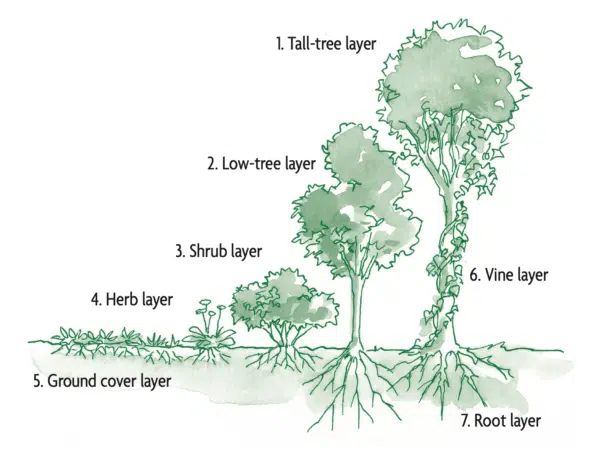
A food forest is a permaculture principle that can be as simple or as complex as you would like to make it. It is the working together of seven different vertical layers of different types of plants to create a symbiotic garden that holds all the benefits of a naturally occurring ecosystem, the way God created it to be.
Have you ever walked through a natural forest and felt awed and insignificant beside the complexity and beauty of the sprawling plantscape? That’s the effect a food forest goes for, and it will look different depending on environmental factors like the climate, the soil type, the rainfall, and the soil depth.
Just a simple food forest can contain three layers: trees, shrubs, and ground plants. Or if you’re feeling up to the challenge, you can take advantage of planting up to seven layers and create a complex diversity of plant life. As the illustration below shows, a seven-layered forest garden contains tall trees, low trees, shrubs, herbs, ground covers, vines, and root crops.
The Tall-Tree Layer
This is the overstory of full-sized fruit, nut, or other useful trees, with spaces between to let plenty of light reach the lower layers.
Dense, spreading species—the classic shade trees such as maple, sycamore, and beech—don’t work well in the forest garden because they cast deep shadows over a large area. You want to avoid these types of trees, especially where your sunlight is more restricted. (for example, in a temperate food forest) Rather, aim for multifunctional trees, such as fruit and nut trees.
Larger Fruit & Nut Trees
These are trees, including standard apple, plum, and pear trees, and full-sized cherries.
Chestnut trees, though quite large, work well, especially if pruned to an open, light-allowing shape. Walnut trees are a great candidate, just bear in mind that some plants don’t pair well with walnut trees because of a substance they excrete from their roots.
Nitrogen-Fixing Trees
Nitrogen-fixing trees will help build soil, and most bear blossoms that attract insects. These include black locust, mesquite, alder, and, in low-frost climates, acacia, algoroba, tagasaste, and carob. Choose carefully, making sure that it fits with your overall vision and that you will have a use for them, from a crafting wood source to a beneficial flowering time for bees, to maximize your food forest’s multipurpose nature. Also, plant them with careful regard to their mature size so that enough light will fall between them to support other plants.
The Low-Tree Layer
Here are many of the same fruits and nuts as in the canopy, but on dwarf and semidwarf rootstocks to keep them low-growing.
Plus, we can plant naturally small trees such as apricot, peach, nectarine, almond, medlar, and mulberry. Here also are shade-tolerant fruit trees such as persimmon and pawpaw. In a smaller forest garden, these small trees can also serve as the canopy layer.
They are easy to prune into open forms, which makes them easier to work with, and more sunlight filters through them into the lower layers of plant life.
The Shrub Layer
This tier includes flowering, fruiting, wildlife-attracting, and other useful shrubs.
There are an overwhelming number of plants in this category, so it might help you to think of categories to help you choose. E.g., Berries, pollinator attractor, medicinal, pest repellent, etc.
Shrubs can come in many different sizes, so they are very versatile to be placed in every nook or opening. More shade-loving plants can be planted beneath the trees, while the sun-loving types can be planted in the sunny spaces between.
The Herb Layer
Here, herb is used in the broad botanical sense to mean nonwoody vegetation: vegetables, flowers, culinary herbs, and cover crops, as well as mulch producers and other soil-building plants. An emphasis is put on perennials, but we won’t rule out choice annuals and self-seeding species, especially if you don’t mind the process of planting out sets every year.
Again, shade-lovers can peek out from beneath taller plants, while sun-loving species need the more open spaces.
The Ground-Cover Layer
These are low, ground-hugging plants—preferably varieties that offer food or habitat—that fit into the edges and the spaces between shrubs and herbs.
Some ground cover plants are more well-known, like strawberries, nasturtium, clover, creeping thyme, but there are wide prostrate varieties of flowers such as phlox and verbena. They play a critical role in weed prevention, occupying ground that would otherwise succumb to invaders. One can also select groundcovers that put nutrients back into the soil, such as nitrogen-boosting clover.
The Vine Layer
This layer is for climbing plants that will climb up trellises and branches, filling all the unused spaces.
There are food plants, such as kiwis, passionflower, and vining berries; and also those for wildlife, such as honeysuckle and trumpet-flower.
These can even include climbing annuals such as squash, cucumbers, and melons.
The Root Layer
The soil gives us yet another layer for the forest garden; the third dimension goes both up and down.
Most of the plants for the root layer should be shallow-rooted, such as garlic and onions, or easy-to-dig types such as potatoes and Jerusalem artichokes.